Happening today, in a couple of hours. This is considered routine.
[Added Friday, December 7, 2012]
On Wednesday, Dr. Adam M. Bowman removed the cataract in my left eye, and replaced it with a device manufactured by Alcon Laboratories, Inc.
Model: SN60WF
Power: 19.5 D
Length (∅T): 13.0mm
Optic (∅B): 6.0mm
SN: 12140254 025
Date: 12/5/12
Eye: L
Patient: Bruce Conrad
Surgeon: Dr. Bowman
Afffix to patient ID card
AcrySof IQ IOL
UV with blue light filter
Alcan Laboratories, Inc.
6201 South Freeway
Fort Worth, TEXAS 76134
Wednesday, December 5, 2012

Thursday, September 27, 2012
The value of struggle
I share with Julián Castro a story about immigrant grandparents.
Both his grandmother Victoria and my father's grandfather Nicholas Muhlestein came to this country, learned the language, found work, and struggled and sacrificed so that their children and grandchildren could have a better life.
Mayor Castro wrote, "In the end, the American dream is not a sprint, or even a marathon, but a relay. Our families don't always cross the finish line in the span of one generation."
In both cases, the grandchildren of the immigrant honor their grandparent, and honor the struggle that led to a better life for them and their children.
The difference between our stories is a couple of generations. But if the grandchildren of Nicholas had been inclined to provide everything for the poor of their generation, then Victoria wouldn't have had to struggle. And Julián might not have even come into being, and certainly wouldn't be honoring his grandmother's struggle as such.
Ought we not to allow those who are entering America in this generation the right to struggle? So that their grandchildren can honor them for the better life provided in the third span of the relay race?
This concerns not only immigrants from other countries, but also those whose families have been in America for generations who are now awakening to the possibilities of the American dream. The first span of the relay race is struggle. The second is consolidation of gains from the first. The third can be full success in the American middle class, perhaps even political success, like Julián and his twin brother, Joaquín.
As Julián says of the middle class, "With hard work, everybody ought to be able to get there. And with hard work, everybody ought to be able to stay there—and go beyond."
The only question is, where is the starting point? And should it still involve a relay race span of struggle? Or can we afford to let everyone start the relay race in the second or even the third span?
Both his grandmother Victoria and my father's grandfather Nicholas Muhlestein came to this country, learned the language, found work, and struggled and sacrificed so that their children and grandchildren could have a better life.
Mayor Castro wrote, "In the end, the American dream is not a sprint, or even a marathon, but a relay. Our families don't always cross the finish line in the span of one generation."
In both cases, the grandchildren of the immigrant honor their grandparent, and honor the struggle that led to a better life for them and their children.
The difference between our stories is a couple of generations. But if the grandchildren of Nicholas had been inclined to provide everything for the poor of their generation, then Victoria wouldn't have had to struggle. And Julián might not have even come into being, and certainly wouldn't be honoring his grandmother's struggle as such.
Ought we not to allow those who are entering America in this generation the right to struggle? So that their grandchildren can honor them for the better life provided in the third span of the relay race?
This concerns not only immigrants from other countries, but also those whose families have been in America for generations who are now awakening to the possibilities of the American dream. The first span of the relay race is struggle. The second is consolidation of gains from the first. The third can be full success in the American middle class, perhaps even political success, like Julián and his twin brother, Joaquín.
As Julián says of the middle class, "With hard work, everybody ought to be able to get there. And with hard work, everybody ought to be able to stay there—and go beyond."
The only question is, where is the starting point? And should it still involve a relay race span of struggle? Or can we afford to let everyone start the relay race in the second or even the third span?
Tuesday, September 4, 2012
Fair
There is another aspect of fair. And that is equal pay for equal work. It is unacceptable when one category of worker is paid less than another.
Monday, September 3, 2012
What is fair?
Fair sounds like a good idea. We learn as children how to share, say, a piece of cake, equally.
That works well for cake. What about the world's wealth?
Should that be shared equally too? Should every man, woman, and child have and control an equal amount of the world's money?
Here's an interesting thought experiment, proposed to me by my uncle when I was a youth. Suppose somehow, that all the money in the world could be brought together in one place and then distributed equally (fairly?) to every person in the world.
The question then, is what would the world look like two, three, or five years later? He convinced me that the distribution of wealth would look much the same as it did before the redistribution, with the majority of the wealth in the hands of relatively few, those who are lucky/smart/clever/ruthless enough*.
If your idea of fairness exactly matches equality, then what is the fair share of taxes which the wealthy should pay? Probably pretty close to the 100% or more of income that has been suggested by some thinkers.
Others believe that fairness means equal opportunities, with the outcome being success for those who are lucky/smart/clever/ruthless enough.
Everyone starts out being able to take advantage of the various opportunities provided by the community. These include various kinds of infrastructure. Some are provided by private interests (e.x. railroads). Others are provided by government and paid for by taxes from a previous generation of successful business people (e.x. Interstate highway system).
Starting from that foundation, the contestants begin. Perhaps one in a hundred will start a business. The rest of us will work for someone else and watch television. Perhaps one in a hundred of the startups will survive the first few years. Perhaps one in a thousand of those will go on to become very successful businesses and build a great deal of wealth for their owners.
Of course, as to the infrastructure, our contestants did not build that. However, as to the business itself, they did build that.
The accumulated wealth of the lucky/smart/clever/ruthless belong to them, and since taxes are inevitable, they ought to pay their fair share. Equality might get involved in the definition of "fair" by asking them to pay the same percentage of their income as do the rest of us.
This post started with "fair" meaning equal share of GDP, and ends with an opposing view meaning equal percentage of earnings/income.
What is your view?
That works well for cake. What about the world's wealth?
Should that be shared equally too? Should every man, woman, and child have and control an equal amount of the world's money?
Here's an interesting thought experiment, proposed to me by my uncle when I was a youth. Suppose somehow, that all the money in the world could be brought together in one place and then distributed equally (fairly?) to every person in the world.
The question then, is what would the world look like two, three, or five years later? He convinced me that the distribution of wealth would look much the same as it did before the redistribution, with the majority of the wealth in the hands of relatively few, those who are lucky/smart/clever/ruthless enough*.
If your idea of fairness exactly matches equality, then what is the fair share of taxes which the wealthy should pay? Probably pretty close to the 100% or more of income that has been suggested by some thinkers.
Others believe that fairness means equal opportunities, with the outcome being success for those who are lucky/smart/clever/ruthless enough.
Everyone starts out being able to take advantage of the various opportunities provided by the community. These include various kinds of infrastructure. Some are provided by private interests (e.x. railroads). Others are provided by government and paid for by taxes from a previous generation of successful business people (e.x. Interstate highway system).
Starting from that foundation, the contestants begin. Perhaps one in a hundred will start a business. The rest of us will work for someone else and watch television. Perhaps one in a hundred of the startups will survive the first few years. Perhaps one in a thousand of those will go on to become very successful businesses and build a great deal of wealth for their owners.
Of course, as to the infrastructure, our contestants did not build that. However, as to the business itself, they did build that.
The accumulated wealth of the lucky/smart/clever/ruthless belong to them, and since taxes are inevitable, they ought to pay their fair share. Equality might get involved in the definition of "fair" by asking them to pay the same percentage of their income as do the rest of us.
This post started with "fair" meaning equal share of GDP, and ends with an opposing view meaning equal percentage of earnings/income.
What is your view?
*choose your description, knowing that your choice will say as much about you as it does about them
Thursday, June 7, 2012
Paradigm shift
Big word for a simple concept. The term is normally used to describe a large shift in scientific thinking. This post describes a couple of small shifts in personal thinking.
On Saturday, as I examined a large tree, I noticed a 6d nail protruding from its bark. Diagram here, with the tree on the left, showing only the bark, with the part of the nail inside the tree colored gray.
 Knowing a bit about nails and wood, particularly soft bark, I began to gently wiggle the nail head back and forth, all while pulling it straight out. I couldn't get it to come out.
While wiggling the nail, I happened to give it a bit of a twist, and suddenly, my mental model of the hidden part of the nail changed.

Oh, the nail had been pounded in at an angle and then bent. With the new understanding, it came out in seconds.

A small shift in thinking had a huge impact on my ability to remove the nail without tools.
Several weeks ago, I moved into a newly renovated office space. In each area of the office, the lights come on automatically as one walks into or through (or out of) the area. After some time without any motion, they turn off automatically.
Last Wednesday, I noticed that they weren't coming on. So, I went over to the sensor and waved at it. Still no lights. Shrugging, I returned to my desk and turned on a lamp. There was enough ambient light to see the keyboard and the screen lights up, so there was no real need for lights anyway.
The next day, same thing. I happened to see the office manager in the break room, so I asked him about it. He said, "That's odd." We walked over to my area, and sure enough the lights didn't come on. Then, he said, "Oh, I know what it is." He walked over to the door into the area from the hallway and flipped a light switch. The lights came on. And the motion sensor has worked since.
Now, I have known about light switches since before I can remember. So it was really odd. The office manager mentioned that when this had happened to him a week or so earlier, he had had to ask someone too. While trying to get a light to come on, why didn't we think to look for a switch?
This is an interesting bit of human nature. If something is done for us long enough, we forget how to do it for ourselves. In this case, only a couple of weeks of having something done for me was enough to disable me. I can't help but see a parallel with the "Nanny State" and believe that it is not necessarily good to do things for people when they are capable of doing for themselves.
On Saturday, as I examined a large tree, I noticed a 6d nail protruding from its bark. Diagram here, with the tree on the left, showing only the bark, with the part of the nail inside the tree colored gray.
While wiggling the nail, I happened to give it a bit of a twist, and suddenly, my mental model of the hidden part of the nail changed.
Oh, the nail had been pounded in at an angle and then bent. With the new understanding, it came out in seconds.
A small shift in thinking had a huge impact on my ability to remove the nail without tools.
Several weeks ago, I moved into a newly renovated office space. In each area of the office, the lights come on automatically as one walks into or through (or out of) the area. After some time without any motion, they turn off automatically.
Last Wednesday, I noticed that they weren't coming on. So, I went over to the sensor and waved at it. Still no lights. Shrugging, I returned to my desk and turned on a lamp. There was enough ambient light to see the keyboard and the screen lights up, so there was no real need for lights anyway.
The next day, same thing. I happened to see the office manager in the break room, so I asked him about it. He said, "That's odd." We walked over to my area, and sure enough the lights didn't come on. Then, he said, "Oh, I know what it is." He walked over to the door into the area from the hallway and flipped a light switch. The lights came on. And the motion sensor has worked since.
Now, I have known about light switches since before I can remember. So it was really odd. The office manager mentioned that when this had happened to him a week or so earlier, he had had to ask someone too. While trying to get a light to come on, why didn't we think to look for a switch?
This is an interesting bit of human nature. If something is done for us long enough, we forget how to do it for ourselves. In this case, only a couple of weeks of having something done for me was enough to disable me. I can't help but see a parallel with the "Nanny State" and believe that it is not necessarily good to do things for people when they are capable of doing for themselves.
Thursday, February 9, 2012
Zero is a number too

But, it is not the number two. However, homophones in English is a different topic (visit this website too to learn about to, two, and too).
Zero is considered a natural number, but we sometimes don't naturally think of it.
This was my case in a previous post, in which I called a fortune self-defeating.
That fortune was actually self-fulfilling.
Since zero is a number, it can also be a sum. The fortune predicted that I would inherit an unexpected sum of money within the year. Until I pulled that little slip of paper out of the cookie, I had not expected any inheritance. Once I had read it, I began to expect one. It never came. In other words, I did indeed inherit an unexpected sum of money!
Zero.
Thursday, October 6, 2011
Self-defeating fortune
Just over a year ago, we went out to dinner. As usual, I played with my food.
Departing from custom, I actually kept the fortune from the fortune cookie. And carried it around in my wallet for over a year.
Just tried photographing it.

I really need a better camera.*
It reads, "You will inherit an unexpected sum of money within the year."
And, I added in pen the date of our outing, "9/26/10".
Once the fortune alerted me to the "sum of money" it was no longer "unexpected" (and was, in fact, actually hoped for) and therefore the inheritance could not occur without contradicting the terms of the fortune.
P.S. Until this post scriptum was added, it went without saying that the expected "unexpected sum of money" was not inherited "within the year."
* [added Oct. 26, 2011] Here is a scanned image:

Departing from custom, I actually kept the fortune from the fortune cookie. And carried it around in my wallet for over a year.
Just tried photographing it.

I really need a better camera.*
It reads, "You will inherit an unexpected sum of money within the year."
And, I added in pen the date of our outing, "9/26/10".
Once the fortune alerted me to the "sum of money" it was no longer "unexpected" (and was, in fact, actually hoped for) and therefore the inheritance could not occur without contradicting the terms of the fortune.
P.S. Until this post scriptum was added, it went without saying that the expected "unexpected sum of money" was not inherited "within the year."
* [added Oct. 26, 2011] Here is a scanned image:

Friday, September 9, 2011
Lost left socks
It's kind of a strange thing how socks get lost*. Where do they go?
And, it's kind of funny to claim that it is the left socks which get lost, because socks are symmetrical, right? So, you really can't tell which are left and which are right until you choose which foot to put them on.
However, a few months ago, I bought 18 pairs of socks which are not symmetrical. They are polo socks** and the left and right socks are distinguishable. Here is a picture of my right ankle wearing a right polo sock.

The little embroidered picture of a mounted polo player is circled in red.
After several months of wearing, laundering, sorting, wearing, etc. it turns out that three of the socks are indeed missing. And, they are all left socks.
Only one data point, and hardly a scientific experiment, but there you have it. Left socks get lost.
[Added 2019/02/13: *the link for "socks get lost" is now a dead link, but I found the page on archive.org (missing its embedded images, but still) and you can visit is here. And **the link for "polo socks" is also a dead link, but you can visit the archived page here.]
And, it's kind of funny to claim that it is the left socks which get lost, because socks are symmetrical, right? So, you really can't tell which are left and which are right until you choose which foot to put them on.
However, a few months ago, I bought 18 pairs of socks which are not symmetrical. They are polo socks** and the left and right socks are distinguishable. Here is a picture of my right ankle wearing a right polo sock.

The little embroidered picture of a mounted polo player is circled in red.
After several months of wearing, laundering, sorting, wearing, etc. it turns out that three of the socks are indeed missing. And, they are all left socks.
Only one data point, and hardly a scientific experiment, but there you have it. Left socks get lost.
[Added 2019/02/13: *the link for "socks get lost" is now a dead link, but I found the page on archive.org (missing its embedded images, but still) and you can visit is here. And **the link for "polo socks" is also a dead link, but you can visit the archived page here.]
Friday, August 26, 2011
Keep on trucking
This is a personal story about a real person, told from a personal viewpoint, and thus may not be completely factual. However, I am telling it as I remember it.
When I lived in Raymond (early to mid 1980's), we had a neighbor named Rulon Dahl. At that time he seemed old, probably about twice my age.
We were both in the same Sunday School class, the class having forty or fifty members. He was influential to me, as he seemed to have a great deal of leadership experience, although he wasn't a leader (that I knew of) at that time. I believe that he is the man on the left in the image on this page. The picture is from 1951, and so was taken more than thirty years before this story took place.
It seemed that nearly every Sunday, Rulon would use the phrase, "keep on trucking" for one reason or another.
One Sunday, with nothing in particular to distinguish itself, the instructor asked him if he could prepare a small presentation for the next week's class. Then added a secondary question, "will you be here next week?" Surprisingly, rather than just agreeing as I would have expected, he said, "God willing and the creek don't rise."
During the week he and his wife were driving to Cardston through a bad snow storm. He pulled over and got out to clean the windshield, and was killed by a passing truck which also sheered off the car door.
It left quite a void when the next Sunday School class came along without Rulon.
Done in by a truck of all things, while clearing off snow that, come spring, would contribute to the creek's rise.
When I lived in Raymond (early to mid 1980's), we had a neighbor named Rulon Dahl. At that time he seemed old, probably about twice my age.
We were both in the same Sunday School class, the class having forty or fifty members. He was influential to me, as he seemed to have a great deal of leadership experience, although he wasn't a leader (that I knew of) at that time. I believe that he is the man on the left in the image on this page. The picture is from 1951, and so was taken more than thirty years before this story took place.
It seemed that nearly every Sunday, Rulon would use the phrase, "keep on trucking" for one reason or another.
One Sunday, with nothing in particular to distinguish itself, the instructor asked him if he could prepare a small presentation for the next week's class. Then added a secondary question, "will you be here next week?" Surprisingly, rather than just agreeing as I would have expected, he said, "God willing and the creek don't rise."
During the week he and his wife were driving to Cardston through a bad snow storm. He pulled over and got out to clean the windshield, and was killed by a passing truck which also sheered off the car door.
It left quite a void when the next Sunday School class came along without Rulon.
Done in by a truck of all things, while clearing off snow that, come spring, would contribute to the creek's rise.
Wednesday, August 17, 2011
Atop the viaduct
Today Salt Lake City's mayor opened the North Temple viaduct to pedestrian and vehicular traffic. The TRAX line which also will cross the railway lines there is still under construction.
At ten a.m. I joined the crowd. In this picture you'll see the face of one of the men who built it. The mayor is also facing the camera in the background. At the right edge you can make out the tuba of the brass band that was playing.

Shortly after 10:15 we walked up to the top of the viaduct. I didn't wait around for the speech, etc. Took this snap looking back on the way back to work.

After crossing the street, I turned back for this view of the viaduct. Nice to have it, as it should cut my daily commute time in half. More when there are trains to wait for.

It was a very hot morning, and it felt good to get my sweaty self out of the sun and back into the air-conditioned office building.
See also posts from last year Bridge out and More on the bridge: less bridge.
At ten a.m. I joined the crowd. In this picture you'll see the face of one of the men who built it. The mayor is also facing the camera in the background. At the right edge you can make out the tuba of the brass band that was playing.

Shortly after 10:15 we walked up to the top of the viaduct. I didn't wait around for the speech, etc. Took this snap looking back on the way back to work.

After crossing the street, I turned back for this view of the viaduct. Nice to have it, as it should cut my daily commute time in half. More when there are trains to wait for.

It was a very hot morning, and it felt good to get my sweaty self out of the sun and back into the air-conditioned office building.
See also posts from last year Bridge out and More on the bridge: less bridge.
Wednesday, August 3, 2011
1920's
I was not on the planet in the 1920's. Just for the record.
My nephew, Patrick, is looking for a 1920's outfit.
This is a suit coat that I couldn't resist purchasing. Unfortunately it doesn't fit me, but I think it might fit him.
 It is tailor made in France and looks a lot better on a person than it does on a hanger. I think it will look great on Patrick.
My nephew, Patrick, is looking for a 1920's outfit.
This is a suit coat that I couldn't resist purchasing. Unfortunately it doesn't fit me, but I think it might fit him.
 It is tailor made in France and looks a lot better on a person than it does on a hanger. I think it will look great on Patrick.
Tuesday, July 19, 2011
Hey buddy, can you spare a dime?
No this is not about the many panhandlers around the Gateway, where I work in Salt Lake City.
It is about an interesting way in which someone got a dime from me.
Which reminds me of the time I got a dime from my Uncle Arnold. He promised he would give me "a dime for every quarter you can stand on edge." Thinking this was a pretty good deal, I ran to my room to get a quarter and made it stand on its edge. He then took the quarter and gave me a dime--true to his word, he had indeed given me a dime for the quarter. When invited to repeat the performance, I declined.
Yesterday, I went to buy lunch at the Gateway Taco Time. My turn in line arrived, I asked for "a soft taco, to go, please." The girl asked, "no cheese?" I told her that I had not said "no cheese", but realized that "go please" and "no cheese" was a reasonable misunderstanding* in the noisy food court.
Then came the matter of price. She quoted a price and I countered by asking for a Gateway discount, showing my Gateway badge. She nodded and asked for $2.42. I gave her two dollar bills, a quarter, a dime, a nickel, and two pennies. She shoved the change around in the palm of her hand for a bit and then said, "two fifty-two." So I fished another quarter out of my pocket and gave it to her. She seemed satisfied and returned the dime and the nickel.
She handed me the receipt and said, "your number is 56." I appreciate that, because it now requires glasses to read anything, but I don't normally wear them, so having the clerk read the number is helpful.
In just a few minutes the order was up and I walked back the office to eat in front of my screen.
Only then, did I casually glance at the receipt. Here is a facsimile:

I'm not exactly sure how to explain this. The correct total was $2.42, which is what I had given her in the first place. The receipt shows that I overpaid her by a dime, and that she returned it to me. Which I did. Which she did not. Odd.
When I told Sara about it, she told me that cashiers whose tills are over at the end of the day are treated with more suspicion than those whose tills are under. I hope this girl remembered to take her ill-gotten dime out of the till before the end of the day. She obviously needed it more than me, and hey, I can spare a dime. Small price for a story.
[Added 07/26/11: Went back to Taco Time for lunch today and had a great experience, being treated very well.]
[Added 08/17/11: The manager responded to this post with a coupon for a free item, and I redeemed it yesterday for another soft taco. Paid attention to the ingredients, which do include grated cheese. Hence the added footnote:
*There was no cheese on the original soft taco (the one that provoked this post), so I guess that I did not clear up the misunderstanding after all.]
It is about an interesting way in which someone got a dime from me.
Which reminds me of the time I got a dime from my Uncle Arnold. He promised he would give me "a dime for every quarter you can stand on edge." Thinking this was a pretty good deal, I ran to my room to get a quarter and made it stand on its edge. He then took the quarter and gave me a dime--true to his word, he had indeed given me a dime for the quarter. When invited to repeat the performance, I declined.
Yesterday, I went to buy lunch at the Gateway Taco Time. My turn in line arrived, I asked for "a soft taco, to go, please." The girl asked, "no cheese?" I told her that I had not said "no cheese", but realized that "go please" and "no cheese" was a reasonable misunderstanding* in the noisy food court.
Then came the matter of price. She quoted a price and I countered by asking for a Gateway discount, showing my Gateway badge. She nodded and asked for $2.42. I gave her two dollar bills, a quarter, a dime, a nickel, and two pennies. She shoved the change around in the palm of her hand for a bit and then said, "two fifty-two." So I fished another quarter out of my pocket and gave it to her. She seemed satisfied and returned the dime and the nickel.
She handed me the receipt and said, "your number is 56." I appreciate that, because it now requires glasses to read anything, but I don't normally wear them, so having the clerk read the number is helpful.
In just a few minutes the order was up and I walked back the office to eat in front of my screen.
Only then, did I casually glance at the receipt. Here is a facsimile:

I'm not exactly sure how to explain this. The correct total was $2.42, which is what I had given her in the first place. The receipt shows that I overpaid her by a dime, and that she returned it to me. Which I did. Which she did not. Odd.
When I told Sara about it, she told me that cashiers whose tills are over at the end of the day are treated with more suspicion than those whose tills are under. I hope this girl remembered to take her ill-gotten dime out of the till before the end of the day. She obviously needed it more than me, and hey, I can spare a dime. Small price for a story.
[Added 07/26/11: Went back to Taco Time for lunch today and had a great experience, being treated very well.]
[Added 08/17/11: The manager responded to this post with a coupon for a free item, and I redeemed it yesterday for another soft taco. Paid attention to the ingredients, which do include grated cheese. Hence the added footnote:
*There was no cheese on the original soft taco (the one that provoked this post), so I guess that I did not clear up the misunderstanding after all.]
Tuesday, April 5, 2011
Fifty years of seconds
Fifty years of seconds is around 1,577,880,000 seconds.
That many seconds ago, a series of lectures was held at M.I.T. in honor of its 100 anniversary (thus, in the spring of 1961).
The lectures were recorded, including questions from the audience, and transcribed. The book was published in 1962: "Management and the computer of the future", Greenberger (ed.).
I am reading that book now, and enjoying it greatly.
Especially enjoyable is the lecture on time-sharing, given by John McCarthy. This was the first public mention of the concept, and McCarthy is widely accepted as the "father" of time-sharing.
The question at hand, then, was whether people would want individual access to a "large" computer, and if so, how this desire could be accommodated.
Now, we know that, yes, they do, and that it will be accommodated by the provision of "small" personal computers and access to the world wide web.
How big is "large" and how small is "small"?
In the 1960's an expenditure of about six million dollars would have provided for a hundred or so terminals to be attached to a computer with about one million words of memory and perhaps as much as 50 million words of secondary (disk) storage. That was considered "large" back then.
Assuming a "word" to be 32 bits (4 bytes), this means that a computer that would satisfy the needs for personal programming for the entire M.I.T. would have 4 M bytes of memory and a 200 M byte hard drive.
Physically, it would fill a large room, and require air conditioning and a team of people to operate.
Wow.
A personal computer today might easily have (as mine does) 8 G bytes of memory and 500 G bytes of hard disk. That's more than 2000 times the computing power required for all of M.I.T. a mere billion and a half seconds ago. It is also connected to the world wide web and a trillion documents.
Physically, it occupies less than a tenth of a cubic foot, and doesn't require air-conditioning.
Wow indeed.
The very last quote of the chapter is about the value of specialized hardware to make the machine more usable. McCarthy warns "...we must be very careful that the money saved in hardware is not spent in programming."
Today, a web site can be put together with no hardware purchase at all. By hosting in the cloud, it would cost pennies an hour to operate. The programming, however, will cost tens of dollars an hour. The money saved in hardware is indeed spent on programming, validating McCarthy's fear.
The world has come a long way at the usual rate of one second per second.
That many seconds ago, a series of lectures was held at M.I.T. in honor of its 100 anniversary (thus, in the spring of 1961).
The lectures were recorded, including questions from the audience, and transcribed. The book was published in 1962: "Management and the computer of the future", Greenberger (ed.).
I am reading that book now, and enjoying it greatly.
Especially enjoyable is the lecture on time-sharing, given by John McCarthy. This was the first public mention of the concept, and McCarthy is widely accepted as the "father" of time-sharing.
The question at hand, then, was whether people would want individual access to a "large" computer, and if so, how this desire could be accommodated.
Now, we know that, yes, they do, and that it will be accommodated by the provision of "small" personal computers and access to the world wide web.
How big is "large" and how small is "small"?
In the 1960's an expenditure of about six million dollars would have provided for a hundred or so terminals to be attached to a computer with about one million words of memory and perhaps as much as 50 million words of secondary (disk) storage. That was considered "large" back then.
Assuming a "word" to be 32 bits (4 bytes), this means that a computer that would satisfy the needs for personal programming for the entire M.I.T. would have 4 M bytes of memory and a 200 M byte hard drive.
Physically, it would fill a large room, and require air conditioning and a team of people to operate.
Wow.
A personal computer today might easily have (as mine does) 8 G bytes of memory and 500 G bytes of hard disk. That's more than 2000 times the computing power required for all of M.I.T. a mere billion and a half seconds ago. It is also connected to the world wide web and a trillion documents.
Physically, it occupies less than a tenth of a cubic foot, and doesn't require air-conditioning.
Wow indeed.
The very last quote of the chapter is about the value of specialized hardware to make the machine more usable. McCarthy warns "...we must be very careful that the money saved in hardware is not spent in programming."
Today, a web site can be put together with no hardware purchase at all. By hosting in the cloud, it would cost pennies an hour to operate. The programming, however, will cost tens of dollars an hour. The money saved in hardware is indeed spent on programming, validating McCarthy's fear.
The world has come a long way at the usual rate of one second per second.
Monday, November 29, 2010
NaBloPoMo 2010
Okay, in honor of National Blog Posting Month, I will make a monthly post this month. Yeah, just one--I know it was supposed to be 30.
This has to do with being a Canadian.
My wonderful wife, along with being very supportive, does make fun of me once in awhile, and often it has to do with something from my Canadian upbringing.
One such thing is the way I pronounce "been" to rhyme with "seen". I present the lyrics from a popular song as evidence of the correctness of my pronunciation.
Oh what a laugh it would have been
If Daddy had only seen
Mommy kissing Santa Claus last night.
This should be a rhyme, right?
However, today on the way home from the funeral of her uncle, we heard the song performed and heard the singer sing "been" like "bin". Sure enough, I am out of touch with others south of the 49th.
This has to do with being a Canadian.
My wonderful wife, along with being very supportive, does make fun of me once in awhile, and often it has to do with something from my Canadian upbringing.
One such thing is the way I pronounce "been" to rhyme with "seen". I present the lyrics from a popular song as evidence of the correctness of my pronunciation.
Oh what a laugh it would have been
If Daddy had only seen
Mommy kissing Santa Claus last night.
This should be a rhyme, right?
However, today on the way home from the funeral of her uncle, we heard the song performed and heard the singer sing "been" like "bin". Sure enough, I am out of touch with others south of the 49th.
Wednesday, October 27, 2010
I owe my life to sugar
I am currently trying a diet which avoids all sugars, in an attempt to manage the symptoms of rosacia.
This is ironic, because I owe my life to sugar.
My family of origin lived on a farm 7½ miles north of Taber. Our mother worked hard inside the home; laundry, meal preparation, childcare, etc. Our father was working in the fields or with the cattle or farm machinery from sunrise to sunset, and often even in the night. We children helped out as needed, and were expected to do well in school and work on our homework as well.
The family income came solely from mixed farming. We had twenty or so beef cattle, mostly cows (except in the Spring), and a milk cow. We had an extensive vegetable garden and fruit trees and bushes. We grew wheat and pastureland, and, especially, sugar beets. I say "especially" because sugar beets were our biggest cash crop, and provided the bulk of the annual income. This crop gave us our lives, and we gave a good deal of our lives over to it. And risked our lives for it: earlier, I have recounted our father's serious accident with our sugar beet harvester in "Farm Injury".
That is how I owe my life to sugar, even though I may now need to stop consuming it.
One final irony, this one political. Over the years, I have been tempted to criticize farm subsidies. You know, talk about farmers being paid to leave their land fallow, and such. During my teenage years, I learned that our cash crop--sugar beets--was subsidized by the Canadian government. It seems that other sources of sugar, from other countries, were much cheaper than the actual cost of producing sugar from sugar beets. So, a free market economy would put the sugar beet industry out of business. However, Canada wants to be independent of other countries for its sugar supply. Therefore, the Canadian government subsidizes the sugar beet industry so that it remains profitable, and so that Canadians can continue to enjoy reasonably-priced sugar regardless of world conditions.
So, I also owe my life to agricultural subsidies, even though I am a fan of a free economy.
While on the subject of ironies of life-owing, this: since I am descended from the second wife of a polygamous great-grandfather, I owe my life to polygamy, even though I oppose polygamy now.
This is ironic, because I owe my life to sugar.
My family of origin lived on a farm 7½ miles north of Taber. Our mother worked hard inside the home; laundry, meal preparation, childcare, etc. Our father was working in the fields or with the cattle or farm machinery from sunrise to sunset, and often even in the night. We children helped out as needed, and were expected to do well in school and work on our homework as well.
The family income came solely from mixed farming. We had twenty or so beef cattle, mostly cows (except in the Spring), and a milk cow. We had an extensive vegetable garden and fruit trees and bushes. We grew wheat and pastureland, and, especially, sugar beets. I say "especially" because sugar beets were our biggest cash crop, and provided the bulk of the annual income. This crop gave us our lives, and we gave a good deal of our lives over to it. And risked our lives for it: earlier, I have recounted our father's serious accident with our sugar beet harvester in "Farm Injury".
That is how I owe my life to sugar, even though I may now need to stop consuming it.
One final irony, this one political. Over the years, I have been tempted to criticize farm subsidies. You know, talk about farmers being paid to leave their land fallow, and such. During my teenage years, I learned that our cash crop--sugar beets--was subsidized by the Canadian government. It seems that other sources of sugar, from other countries, were much cheaper than the actual cost of producing sugar from sugar beets. So, a free market economy would put the sugar beet industry out of business. However, Canada wants to be independent of other countries for its sugar supply. Therefore, the Canadian government subsidizes the sugar beet industry so that it remains profitable, and so that Canadians can continue to enjoy reasonably-priced sugar regardless of world conditions.
So, I also owe my life to agricultural subsidies, even though I am a fan of a free economy.
While on the subject of ironies of life-owing, this: since I am descended from the second wife of a polygamous great-grandfather, I owe my life to polygamy, even though I oppose polygamy now.
Monday, September 27, 2010
Playing with food
Okay, this is another bit of proof that I am weird.

Anyone can read this blog, of course, since it is on the public Internet. But, my main purpose in writing it is to record a few things that might be of interest someday to my children. Most of the interesting dialog that happens in my head never goes any further. So, here is a tiny fraction of one evening's worth.
Last night, my wife and I took her son and his girlfriend out to dinner at a Chinese buffet. As usual, I created a symmetrical work of art out of each plateful, as I selected it. The last plate was a bit boring at first, so I played around with it while eating. And--can you believe it?--actually took a picture of it.

This reminded me of eating grapes with my sisters around the kitchen table in the farmhouse when we were kids. Grapes were not an everyday food then, and quite a treat when we got to have some. And, we did things like hold one stem upright, so that it looked like a tree. Then we would tell each other stories about Farmer Brown and his harvest, as we picked and ate one grape at a time. Fond memories.
Friday, August 13, 2010
Friday Flashback: Near-death experiences
Disclaimer: the phrase "near-death experiences" usually refers to cases where a person is medically dead, and subsequently revived. In this post, I am talking about cases where I came close to dying, but did not actually do so.
I will mention four of these in this post, although there have been others.
1. At age 15, I fell with a telephone pole while doing some repairs at the top of it. This has already been told in full in "Fall on a Spring day".
2. At age 20, while walking the streets of Geneva, Switzerland, my companion and I approached a street corner and the sidewalk narrowed to a few inches, so we were walking single file. Just as I reached the corner, a city bus came around the corner with its mirror just missing the wall. It was at eye level. Fortunately, I ducked in time, as did my companion.
3. A few months later, in Béziers, France, I was on "splits" with a Zone Leader. He was able to drive a car (while I only had a "moped") and I was in the passenger seat. We pulled up to a stop sign at a narrow road which allowed trucks to by-pass the city. He looked both ways (even though it was a one-way road) and then, instead of pulling forward, leaned back and continued talking to me about something. Moments later, he must have seen a car pull up behind him, out of the corner of his eye in the rear-view mirror, so he started moving. I saw an 18 wheeler bearing down on us at top speed and so yelled, «attention!» (French for "look out!). He hit the brakes, and the truck hit us. I can still see each set of wheels going up, over the top of our engine, and down. One after the other, each axle of wheels slammed into and over the car, just inches in front of our faces. Strangely, the car wasn't moved laterally. Just smashed. And, we survived uninjured.
4. When I was approaching 40, and had two young children, my wife and I, along with Elizabeth and Andrew were in our Plymouth minivan, south of Springville, Utah. We were stopped at a railway level crossing by blinking red warning lights. There was no barrier. We waited what seemed like several minutes. No train. Must have been a malfunction of some kind? Just as I was relaxing my brake foot and getting ready to cross, a freight train screamed past. Yet another close call.
I will mention four of these in this post, although there have been others.
1. At age 15, I fell with a telephone pole while doing some repairs at the top of it. This has already been told in full in "Fall on a Spring day".
2. At age 20, while walking the streets of Geneva, Switzerland, my companion and I approached a street corner and the sidewalk narrowed to a few inches, so we were walking single file. Just as I reached the corner, a city bus came around the corner with its mirror just missing the wall. It was at eye level. Fortunately, I ducked in time, as did my companion.
3. A few months later, in Béziers, France, I was on "splits" with a Zone Leader. He was able to drive a car (while I only had a "moped") and I was in the passenger seat. We pulled up to a stop sign at a narrow road which allowed trucks to by-pass the city. He looked both ways (even though it was a one-way road) and then, instead of pulling forward, leaned back and continued talking to me about something. Moments later, he must have seen a car pull up behind him, out of the corner of his eye in the rear-view mirror, so he started moving. I saw an 18 wheeler bearing down on us at top speed and so yelled, «attention!» (French for "look out!). He hit the brakes, and the truck hit us. I can still see each set of wheels going up, over the top of our engine, and down. One after the other, each axle of wheels slammed into and over the car, just inches in front of our faces. Strangely, the car wasn't moved laterally. Just smashed. And, we survived uninjured.
4. When I was approaching 40, and had two young children, my wife and I, along with Elizabeth and Andrew were in our Plymouth minivan, south of Springville, Utah. We were stopped at a railway level crossing by blinking red warning lights. There was no barrier. We waited what seemed like several minutes. No train. Must have been a malfunction of some kind? Just as I was relaxing my brake foot and getting ready to cross, a freight train screamed past. Yet another close call.
Friday, July 9, 2010
Friday Flashback: Western stories
False advertising alert: since I grew up in the West, technically all of my stories are Western stories. Well, anyway, let me ramble through a few.
This post is partly about television. Our family purchased a first TV set sometime in the late 50's or early 60's. I particularly enjoyed westerns, especially John Wayne. While watching one one evening, I became enamored of the phrase, "put up your dukes." The next day, I tried it out at school and the kid promptly knocked me to the floor! This was in elementary school, as we were walking out the door for recess. Needless to say, I never used the phrase again (without heavy quotes) and didn't get into any more fights.
About this time, a few friends and I formed a science club in elementary school. One of the kids kind of took everything over, so the rest of us quit the club.
In my Junior High School days, I had a favorite TV show. Just after arriving home on the school bus, Fireball XL-5 came on, and I watched it every chance I had. Even though color TV's were available at the time, we had a black and white set. And, one channel, channel 7 out of Lethbridge.
My sister and I both wrote stories for that western newspaper, the Winnipeg Free Press Weekly. The one that appeared from me had the pen name of "Solar Scout," another indication of my early interest in space travel.
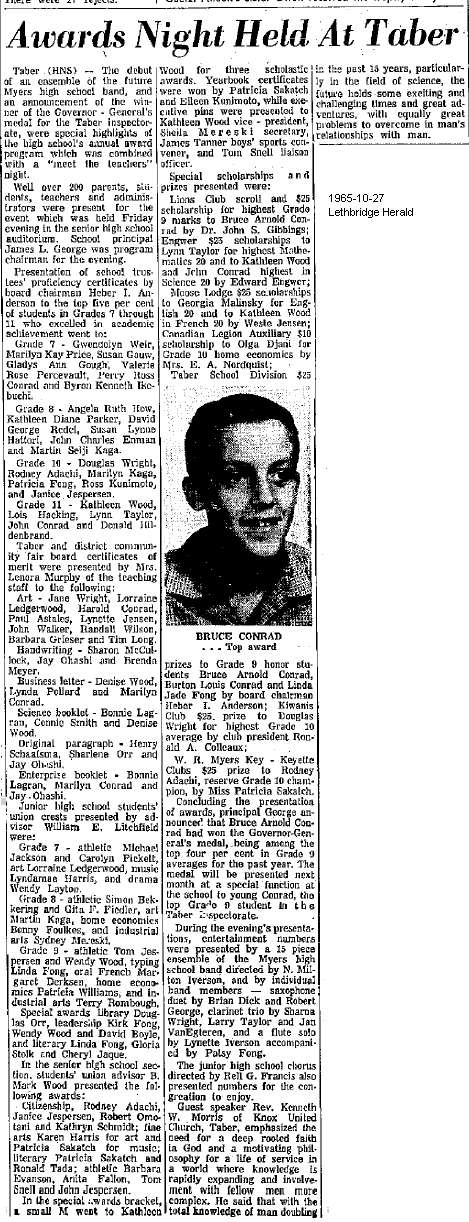
All of this dreaming about space travel might have helped motivate me to get good grades, culminating in the ninth grade with my receiving the Governor General's medal. An article in the Lethbridge Herald covered the announcement.

Later, in High School, some of us organized a science club, called the Apogee Scientific Organization. We flew model rockets, among other things.
Just after graduating, during the summer, I hit a softball for the first time in my life (other than practicing alone). It was actually a home run, and very sweet, because one of my former school mates happened to be walking by at the time, and as I ran to first, I heard him ask in wonderment, "was that Conrad who hit that?"
This post is partly about television. Our family purchased a first TV set sometime in the late 50's or early 60's. I particularly enjoyed westerns, especially John Wayne. While watching one one evening, I became enamored of the phrase, "put up your dukes." The next day, I tried it out at school and the kid promptly knocked me to the floor! This was in elementary school, as we were walking out the door for recess. Needless to say, I never used the phrase again (without heavy quotes) and didn't get into any more fights.
About this time, a few friends and I formed a science club in elementary school. One of the kids kind of took everything over, so the rest of us quit the club.
In my Junior High School days, I had a favorite TV show. Just after arriving home on the school bus, Fireball XL-5 came on, and I watched it every chance I had. Even though color TV's were available at the time, we had a black and white set. And, one channel, channel 7 out of Lethbridge.
My sister and I both wrote stories for that western newspaper, the Winnipeg Free Press Weekly. The one that appeared from me had the pen name of "Solar Scout," another indication of my early interest in space travel.
All of this dreaming about space travel might have helped motivate me to get good grades, culminating in the ninth grade with my receiving the Governor General's medal. An article in the Lethbridge Herald covered the announcement.

Later, in High School, some of us organized a science club, called the Apogee Scientific Organization. We flew model rockets, among other things.
Just after graduating, during the summer, I hit a softball for the first time in my life (other than practicing alone). It was actually a home run, and very sweet, because one of my former school mates happened to be walking by at the time, and as I ran to first, I heard him ask in wonderment, "was that Conrad who hit that?"
Monday, June 21, 2010
Ingenuity
The seat belt buckle is held above the floor by a little plastic button that is riveted onto the seat belt at the right height. The plastic button is black and visible in the middle of the belt towards the bottom of this picture.

Sometimes, it breaks off. Thereafter it can become difficult to find the buckle, because it can slide along the belt all the way to the floor.
I first tried a safety pin for awhile, reasoning that the small hole in the belt must not be a safety hazard because the hole is there for the original equipment button in the first place. However, when the safety pin comes undone, it can cause some damage to a questing hand.
So, I used a large keyring. Carefully starting it through the pre-existing hole in the seat belt, I worked it around until it was entirely in place, encircling half of the belt. It is clearly visible around the right half of the belt midway down the picture.

This works very well, and the questing hand can find it easily, and without injury.

Sometimes, it breaks off. Thereafter it can become difficult to find the buckle, because it can slide along the belt all the way to the floor.
I first tried a safety pin for awhile, reasoning that the small hole in the belt must not be a safety hazard because the hole is there for the original equipment button in the first place. However, when the safety pin comes undone, it can cause some damage to a questing hand.
So, I used a large keyring. Carefully starting it through the pre-existing hole in the seat belt, I worked it around until it was entirely in place, encircling half of the belt. It is clearly visible around the right half of the belt midway down the picture.

This works very well, and the questing hand can find it easily, and without injury.
Friday, June 11, 2010
Friday Flashback: Public Speaking
As most of my readers know, I was raised in a family that belongs to The Church of Jesus Christ of Latter-day Saints. During the growing up years, we just considered ourselves to be Mormon, and that's what everyone around called us, as well.
Part of the religious practice is to attend a Sunday meeting called "Sacrament Meeting" which includes speakers chosen from among the members of the congregation (called a "ward").
At that time, it was customary to have one or two "youth speakers" start out early on in the meeting. They were customarily followed by two or three adult speakers. When I was 12, I got my first opportunity to be a youth speaker.
When I stood at the pulpit, I began to cry out of fear or tension or something. I couldn't seem to get control. My dad, who was seated on the stand behind me, as a member of the bishopric, came and stood beside me, with his arm around my shoulder, while I composed myself. He sat down once I started to give my talk.
I have always appreciated his gesture. Many a time I overheard him in our home asking my mother with some exasperation, "why is he crying?" I can't remember her answer, nor do I really know myself why. But, I used to cry quite easily as a child.
After this traumatic public experience of crying, I had a stern talk with myself, and mostly control myself ever since.
Part of the religious practice is to attend a Sunday meeting called "Sacrament Meeting" which includes speakers chosen from among the members of the congregation (called a "ward").
At that time, it was customary to have one or two "youth speakers" start out early on in the meeting. They were customarily followed by two or three adult speakers. When I was 12, I got my first opportunity to be a youth speaker.
When I stood at the pulpit, I began to cry out of fear or tension or something. I couldn't seem to get control. My dad, who was seated on the stand behind me, as a member of the bishopric, came and stood beside me, with his arm around my shoulder, while I composed myself. He sat down once I started to give my talk.
I have always appreciated his gesture. Many a time I overheard him in our home asking my mother with some exasperation, "why is he crying?" I can't remember her answer, nor do I really know myself why. But, I used to cry quite easily as a child.
After this traumatic public experience of crying, I had a stern talk with myself, and mostly control myself ever since.
Subscribe to:
Posts (Atom)