Tuesday, July 19, 2011

Hey buddy, can you spare a dime?

No this is not about the many panhandlers around the Gateway, where I work in Salt Lake City.

It is about an interesting way in which someone got a dime from me.

Which reminds me of the time I got a dime from my Uncle Arnold. He promised he would give me "a dime for every quarter you can stand on edge." Thinking this was a pretty good deal, I ran to my room to get a quarter and made it stand on its edge. He then took the quarter and gave me a dime--true to his word, he had indeed given me a dime for the quarter. When invited to repeat the performance, I declined.

Yesterday, I went to buy lunch at the Gateway Taco Time. My turn in line arrived, I asked for "a soft taco, to go, please." The girl asked, "no cheese?" I told her that I had not said "no cheese", but realized that "go please" and "no cheese" was a reasonable misunderstanding* in the noisy food court.

Then came the matter of price. She quoted a price and I countered by asking for a Gateway discount, showing my Gateway badge. She nodded and asked for $2.42. I gave her two dollar bills, a quarter, a dime, a nickel, and two pennies. She shoved the change around in the palm of her hand for a bit and then said, "two fifty-two." So I fished another quarter out of my pocket and gave it to her. She seemed satisfied and returned the dime and the nickel.

She handed me the receipt and said, "your number is 56." I appreciate that, because it now requires glasses to read anything, but I don't normally wear them, so having the clerk read the number is helpful.

In just a few minutes the order was up and I walked back the office to eat in front of my screen.

Only then, did I casually glance at the receipt. Here is a facsimile:


I'm not exactly sure how to explain this. The correct total was $2.42, which is what I had given her in the first place. The receipt shows that I overpaid her by a dime, and that she returned it to me. Which I did. Which she did not. Odd.

When I told Sara about it, she told me that cashiers whose tills are over at the end of the day are treated with more suspicion than those whose tills are under. I hope this girl remembered to take her ill-gotten dime out of the till before the end of the day. She obviously needed it more than me, and hey, I can spare a dime. Small price for a story.

[Added 07/26/11: Went back to Taco Time for lunch today and had a great experience, being treated very well.]

[Added 08/17/11: The manager responded to this post with a coupon for a free item, and I redeemed it yesterday for another soft taco. Paid attention to the ingredients, which do include grated cheese. Hence the added footnote:

*There was no cheese on the original soft taco (the one that provoked this post), so I guess that I did not clear up the misunderstanding after all.]

Tuesday, April 5, 2011

Fifty years of seconds

Fifty years of seconds is around 1,577,880,000 seconds.

That many seconds ago, a series of lectures was held at M.I.T. in honor of its 100 anniversary (thus, in the spring of 1961).

The lectures were recorded, including questions from the audience, and transcribed. The book was published in 1962: "Management and the computer of the future", Greenberger (ed.).

I am reading that book now, and enjoying it greatly.

Especially enjoyable is the lecture on time-sharing, given by John McCarthy. This was the first public mention of the concept, and McCarthy is widely accepted as the "father" of time-sharing.

The question at hand, then, was whether people would want individual access to a "large" computer, and if so, how this desire could be accommodated.

Now, we know that, yes, they do, and that it will be accommodated by the provision of "small" personal computers and access to the world wide web.

How big is "large" and how small is "small"?

In the 1960's an expenditure of about six million dollars would have provided for a hundred or so terminals to be attached to a computer with about one million words of memory and perhaps as much as 50 million words of secondary (disk) storage. That was considered "large" back then.

Assuming a "word" to be 32 bits (4 bytes), this means that a computer that would satisfy the needs for personal programming for the entire M.I.T. would have 4 M bytes of memory and a 200 M byte hard drive.

Physically, it would fill a large room, and require air conditioning and a team of people to operate.

Wow.

A personal computer today might easily have (as mine does) 8 G bytes of memory and 500 G bytes of hard disk. That's more than 2000 times the computing power required for all of M.I.T. a mere billion and a half seconds ago. It is also connected to the world wide web and a trillion documents.

Physically, it occupies less than a tenth of a cubic foot, and doesn't require air-conditioning.

Wow indeed.

The very last quote of the chapter is about the value of specialized hardware to make the machine more usable. McCarthy warns "...we must be very careful that the money saved in hardware is not spent in programming."

Today, a web site can be put together with no hardware purchase at all. By hosting in the cloud, it would cost pennies an hour to operate. The programming, however, will cost tens of dollars an hour. The money saved in hardware is indeed spent on programming, validating McCarthy's fear.

The world has come a long way at the usual rate of one second per second.

Monday, November 29, 2010

NaBloPoMo 2010

Okay, in honor of National Blog Posting Month, I will make a monthly post this month. Yeah, just one--I know it was supposed to be 30.

This has to do with being a Canadian.

My wonderful wife, along with being very supportive, does make fun of me once in awhile, and often it has to do with something from my Canadian upbringing.

One such thing is the way I pronounce "been" to rhyme with "seen". I present the lyrics from a popular song as evidence of the correctness of my pronunciation.

Oh what a laugh it would have been
If Daddy had only seen
Mommy kissing Santa Claus last night.

This should be a rhyme, right?

However, today on the way home from the funeral of her uncle, we heard the song performed and heard the singer sing "been" like "bin". Sure enough, I am out of touch with others south of the 49th.

Wednesday, October 27, 2010

I owe my life to sugar

I am currently trying a diet which avoids all sugars, in an attempt to manage the symptoms of rosacia.

This is ironic, because I owe my life to sugar.

My family of origin lived on a farm 7½ miles north of Taber. Our mother worked hard inside the home; laundry, meal preparation, childcare, etc. Our father was working in the fields or with the cattle or farm machinery from sunrise to sunset, and often even in the night. We children helped out as needed, and were expected to do well in school and work on our homework as well.

The family income came solely from mixed farming. We had twenty or so beef cattle, mostly cows (except in the Spring), and a milk cow. We had an extensive vegetable garden and fruit trees and bushes. We grew wheat and pastureland, and, especially, sugar beets. I say "especially" because sugar beets were our biggest cash crop, and provided the bulk of the annual income. This crop gave us our lives, and we gave a good deal of our lives over to it. And risked our lives for it: earlier, I have recounted our father's serious accident with our sugar beet harvester in "Farm Injury".

That is how I owe my life to sugar, even though I may now need to stop consuming it.

One final irony, this one political. Over the years, I have been tempted to criticize farm subsidies. You know, talk about farmers being paid to leave their land fallow, and such. During my teenage years, I learned that our cash crop--sugar beets--was subsidized by the Canadian government. It seems that other sources of sugar, from other countries, were much cheaper than the actual cost of producing sugar from sugar beets. So, a free market economy would put the sugar beet industry out of business. However, Canada wants to be independent of other countries for its sugar supply. Therefore, the Canadian government subsidizes the sugar beet industry so that it remains profitable, and so that Canadians can continue to enjoy reasonably-priced sugar regardless of world conditions.

So, I also owe my life to agricultural subsidies, even though I am a fan of a free economy.

While on the subject of ironies of life-owing, this: since I am descended from the second wife of a polygamous great-grandfather, I owe my life to polygamy, even though I oppose polygamy now.

Monday, September 27, 2010

Playing with food

Okay, this is another bit of proof that I am weird.

Anyone can read this blog, of course, since it is on the public Internet. But, my main purpose in writing it is to record a few things that might be of interest someday to my children. Most of the interesting dialog that happens in my head never goes any further. So, here is a tiny fraction of one evening's worth.

Last night, my wife and I took her son and his girlfriend out to dinner at a Chinese buffet. As usual, I created a symmetrical work of art out of each plateful, as I selected it. The last plate was a bit boring at first, so I played around with it while eating. And--can you believe it?--actually took a picture of it.


This reminded me of eating grapes with my sisters around the kitchen table in the farmhouse when we were kids. Grapes were not an everyday food then, and quite a treat when we got to have some. And, we did things like hold one stem upright, so that it looked like a tree. Then we would tell each other stories about Farmer Brown and his harvest, as we picked and ate one grape at a time. Fond memories.

Friday, August 13, 2010

Friday Flashback: Near-death experiences

Disclaimer: the phrase "near-death experiences" usually refers to cases where a person is medically dead, and subsequently revived. In this post, I am talking about cases where I came close to dying, but did not actually do so.

I will mention four of these in this post, although there have been others.

1. At age 15, I fell with a telephone pole while doing some repairs at the top of it. This has already been told in full in "Fall on a Spring day".

2. At age 20, while walking the streets of Geneva, Switzerland, my companion and I approached a street corner and the sidewalk narrowed to a few inches, so we were walking single file. Just as I reached the corner, a city bus came around the corner with its mirror just missing the wall. It was at eye level. Fortunately, I ducked in time, as did my companion.

3. A few months later, in Béziers, France, I was on "splits" with a Zone Leader. He was able to drive a car (while I only had a "moped") and I was in the passenger seat. We pulled up to a stop sign at a narrow road which allowed trucks to by-pass the city. He looked both ways (even though it was a one-way road) and then, instead of pulling forward, leaned back and continued talking to me about something. Moments later, he must have seen a car pull up behind him, out of the corner of his eye in the rear-view mirror, so he started moving. I saw an 18 wheeler bearing down on us at top speed and so yelled, «attention!» (French for "look out!). He hit the brakes, and the truck hit us. I can still see each set of wheels going up, over the top of our engine, and down. One after the other, each axle of wheels slammed into and over the car, just inches in front of our faces. Strangely, the car wasn't moved laterally. Just smashed. And, we survived uninjured.

4. When I was approaching 40, and had two young children, my wife and I, along with Elizabeth and Andrew were in our Plymouth minivan, south of Springville, Utah. We were stopped at a railway level crossing by blinking red warning lights. There was no barrier. We waited what seemed like several minutes. No train. Must have been a malfunction of some kind? Just as I was relaxing my brake foot and getting ready to cross, a freight train screamed past. Yet another close call.

Friday, July 9, 2010

Friday Flashback: Western stories

False advertising alert: since I grew up in the West, technically all of my stories are Western stories. Well, anyway, let me ramble through a few.

This post is partly about television. Our family purchased a first TV set sometime in the late 50's or early 60's. I particularly enjoyed westerns, especially John Wayne. While watching one one evening, I became enamored of the phrase, "put up your dukes." The next day, I tried it out at school and the kid promptly knocked me to the floor! This was in elementary school, as we were walking out the door for recess. Needless to say, I never used the phrase again (without heavy quotes) and didn't get into any more fights.

About this time, a few friends and I formed a science club in elementary school. One of the kids kind of took everything over, so the rest of us quit the club.

In my Junior High School days, I had a favorite TV show. Just after arriving home on the school bus, Fireball XL-5 came on, and I watched it every chance I had. Even though color TV's were available at the time, we had a black and white set. And, one channel, channel 7 out of Lethbridge.

My sister and I both wrote stories for that western newspaper, the Winnipeg Free Press Weekly. The one that appeared from me had the pen name of "Solar Scout," another indication of my early interest in space travel.

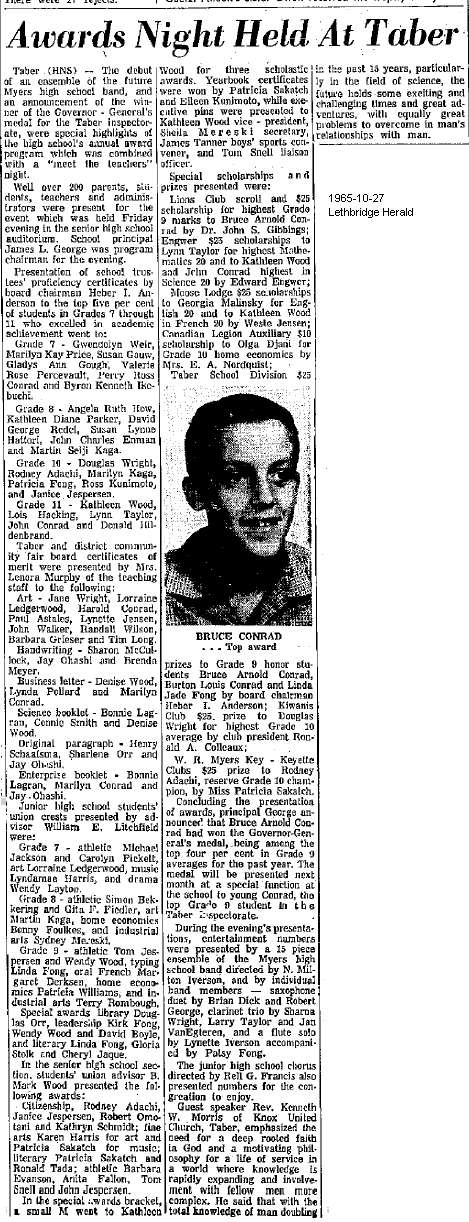
All of this dreaming about space travel might have helped motivate me to get good grades, culminating in the ninth grade with my receiving the Governor General's medal. An article in the Lethbridge Herald covered the announcement.


Later, in High School, some of us organized a science club, called the Apogee Scientific Organization. We flew model rockets, among other things.

Just after graduating, during the summer, I hit a softball for the first time in my life (other than practicing alone). It was actually a home run, and very sweet, because one of my former school mates happened to be walking by at the time, and as I ran to first, I heard him ask in wonderment, "was that Conrad who hit that?"